
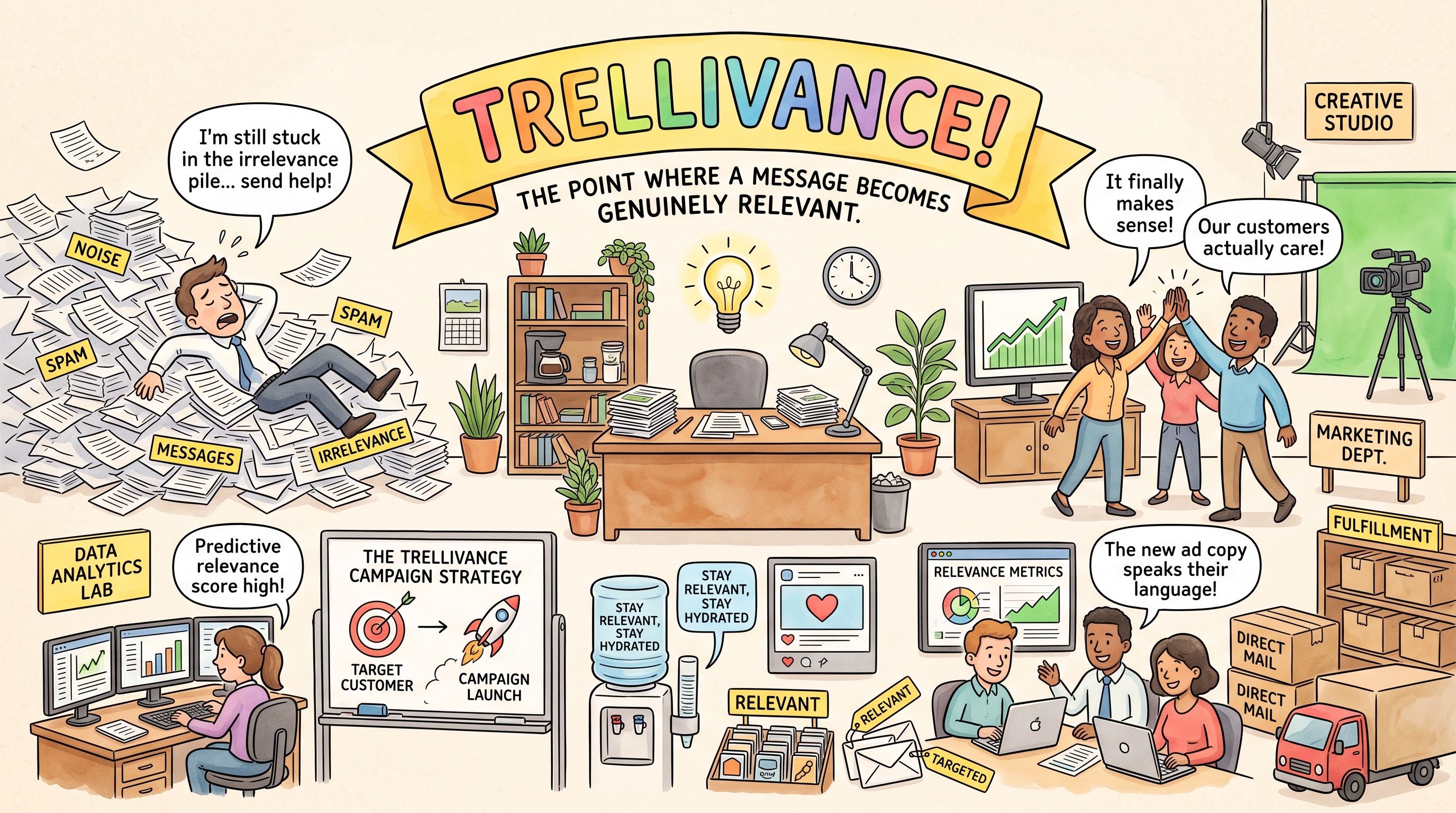

Trellivance is the word I coined for the moment a marketing message finally lands. After 27 years of building businesses, I've watched more good companies lose to bad messaging than to bad products. The product works. The service is real. The team is capable. And still the marketing falls flat, not because the message is wrong, but because it never reaches the one moment that matters. There wasn't a clean word for that moment, so I made one.
Trellivance (treh-LIV-ance): noun. The point at which a message becomes genuinely relevant.
Not relevant in the box-ticking, technically-on-topic sense. Genuinely relevant: the instant a message stops being about your company and becomes about the person reading it, right now, in a way they can feel. Everything before that instant is noise. Everything after it is possibility. The whole job of marketing is getting the reader to that point before they leave.
The word is built on purpose. "Trelli-" borrows the shape of trellis: a structure a growing thing climbs and takes form on. "-vance" pulls from relevance, resonance, and advance. Put together, it means exactly what it says: the structured moment a message climbs into relevance and moves the reader forward.
Why I Needed a Word for Trellivance
Naming a thing changes how you work with it. Before "user experience" was a phrase, teams shipped confusing products with no shared way to point at the problem. A precise word turns a vague feeling into something you can measure, discuss, and deliberately engineer.
"Make it more relevant" is the kind of feedback that means nothing, because it points at a whole atmosphere instead of a specific event. Relevance is a state. Trellivance is a moment: the exact point where the fog burns off and the reader sees themselves in your words. You can't optimize a state directly. You can optimize the moment you reach it. You can make it come sooner, hit harder, and happen more often. That distinction is the difference between marketing you can only critique and marketing you can actually fix.
How to Use Trellivance
Trellivance is a noun for the moment itself, and it flexes into a small, useful word family:
Trellivance (noun): the point of genuine relevance. "The email didn't hit trellivance until the third paragraph: two paragraphs too late."
Trellivant (adjective): having reached that point. "That opening line is instantly trellivant."
Trellivate (verb): to bring a message to the point of relevance. "We need to trellivate the hero section: right now it's talking about us, not them."
Three ways it earns its keep in real work:
As a diagnostic. Instead of "this copy is weak," you ask a precise question: where does this hit trellivance, and how long does it take to get there? Most underperforming marketing has the same disease: trellivance arrives too late, buried under company history, credentials, and throat-clearing. Name the moment and you can drag it to the front.
As a metric. Time-to-trellivance is a real thing you can shorten. A great cold email reaches it in the first line. A great landing page reaches it before the fold. A great pitch reaches it before the prospect's patience runs out. "How fast do we hit trellivance?" is a sharper question than "is this good?"
As a shared language for your team. "Make it pop" is untestable. "This section doesn't reach trellivance until the reader has already scrolled past it" is a note someone can act on Monday morning.
What Trellivance Looks Like in Practice
Let me show you with an illustration: a composite of a pattern I've seen play out in dozens of companies. Call the company DeskDrop: software that automatically files and tags the messy attachments piling up in a support team's inbox. Real problem, real product, and for months, almost no traction.
Here's how their cold outreach opened:
"Hi {Name}, I'm the founder of DeskDrop, an AI-powered document management platform that leverages intelligent tagging to streamline your operational workflows. We work with companies like yours to optimize efficiency..."
Reply rate: effectively zero. And the problem wasn't the product. Every word of that message was about DeskDrop: its category, its features, its adjectives. A support manager reading it feels nothing, because nothing in it is about her. Trellivance never arrives, so she never arrives either. She's gone before the first comma does any work.
They rewrote it around a single question: what does this person actually feel at 4:58 on a Friday?
"Hi {Name}, quick guess: your support team has a shared inbox with about 300 unfiled attachments in it right now, and nobody wants to be the one to sort them. That specific pile is the thing we make disappear. Worth two minutes?"
Same founder. Same product. Same length. The reply rate went from a rounding error to double digits. The only thing that changed was when the message reached trellivance. The first version delayed it forever behind a wall of self-description. The second reached it in the first sentence, "300 unfiled attachments nobody wants to sort", because that line isn't about the software. It's about the reader's actual, specific, felt reality. The moment she recognizes her own inbox in those words, the message becomes trellivant, and a trellivant message gets a reply.
That team started using the word as a working tool. Every draft got the same edit note: where's the trellivance, and why isn't it in line one? Their homepage got the same treatment. They cut three paragraphs of company history off the top and led with the customer's problem. Time on page climbed. One word gave them a single, sharp target instead of a vague instruction to "be more compelling."
The One Question Worth Stapling to Your Desk
Every message you send is a race between two clocks: the reader's patience running down, and your message climbing toward relevance. Trellivance is the moment those two lines cross. Win that race and you get read, remembered, and answered. Lose it and it genuinely does not matter how good your product, your offer, or your prose is: nobody got far enough to find out.
So for every email, headline, landing page, and pitch, ask the same thing:
Where does this hit trellivance, and can I make it happen sooner?
Score Your Own Copy: The Trellivance Test
I turned that question into a scorecard you can run in two minutes. The Trellivance Test scores any landing page, homepage hero, or cold email out of 21 across seven criteria, and tells you which single thing to fix first. No email required, and it is free to reuse with attribution.
That's the word. Steal it, use it, build better messages with it. And the next time a piece of marketing just won't land, you'll finally have the language to say exactly what's wrong: it never reached trellivance. (And if you're wondering whether an article about a coined word can even rank in search. We've run that experiment before.)
- Trellivance (noun): the point at which a message becomes genuinely relevant to the reader.
- Relevance is a state; trellivance is a moment, and moments can be engineered, measured, and moved earlier.
- Time-to-trellivance is the metric: great cold emails reach it in the first line, great landing pages before the fold.
- Every message is a race between the reader's patience and your climb toward relevance: trellivance is where the lines cross.